Sinaw-Al Mutayla
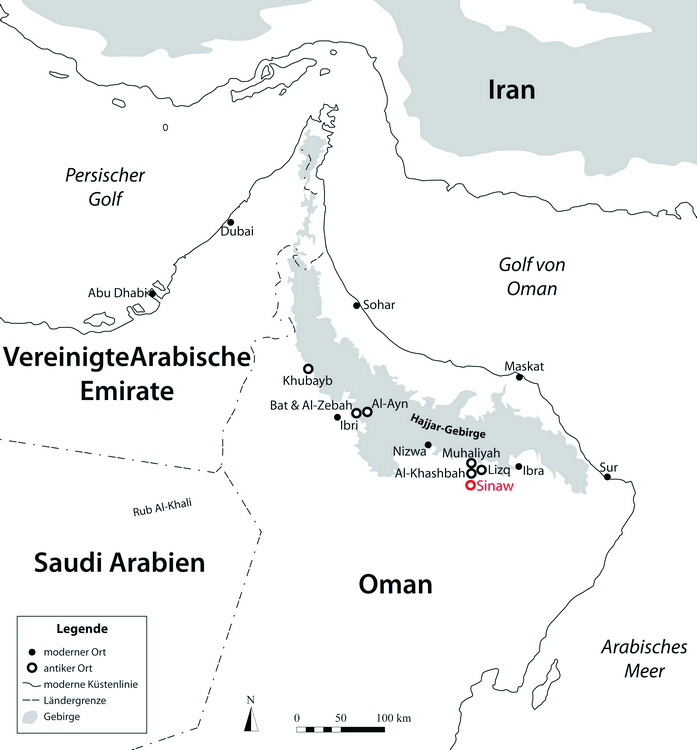
The site is located in the governorate of Shamal Al-Sharqiya, on the northern outskirts of the city of Sinaw and 2 km southeast of the village of Al Mutayla. It is situated on a natural hillock composed of porous calcrete, which is 350 m long, 80 m wide and up to 2 m high. Similar elevated areas in the immediate vicinity appear to be empty, except for a few graves. To the east of the settlement is the main branch of the Wadi Samad, to the west a 10 m high terrace with at least 37 reused Hafit graves from the Iron Age, and behind this the Wadi Andam. To the south, the settlement and the Wadi Samad are cut through by the Sinaw bypass road, which was built in 2017 and has mainly affected the southern part of the site. Gardens and other agricultural land may once have been located here, but these have now been destroyed or built over.
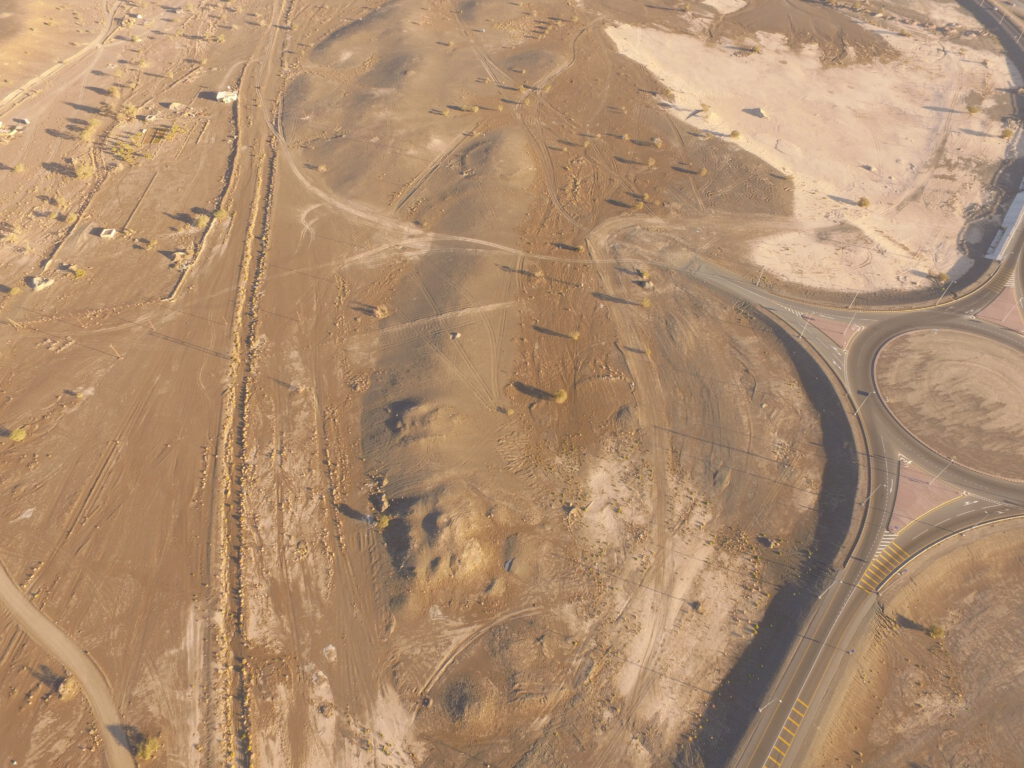
Aerial view of Sinaw-Al Mutayla.
Preliminary work
As part of the Al-Mudhaybi Regional Survey, led by Stephanie Döpper (Goethe University Frankfurt), some pottery was collected from the surface in 2020. Analysis of the ceramics revealed that they date exclusively to the Iron Age, with the vast majority belonging to Iron Age II (1100–600 BC).
From 2022 to 2024, Conrad Schmidt (University of Tübingen) conducted aerial surveys and geophysical prospections. The latter covered the entire hillock and part of the adjacent southern plain. These revealed numerous fireplace remains and confirmed the presence of two square buildings and two unidentifiable structures, including a hexagonal enclosure wall surrounding an open area of approximately 1,600 m². The aerial surveys provided a more detailed picture of the four buildings or structures. The two square buildings are stone structures measuring up to 30 x 30 metres and are comparatively well preserved. One of them contains a well. The outer walls of the buildings and parts of the interior structures are clearly visible in the digital elevation model (DEM).
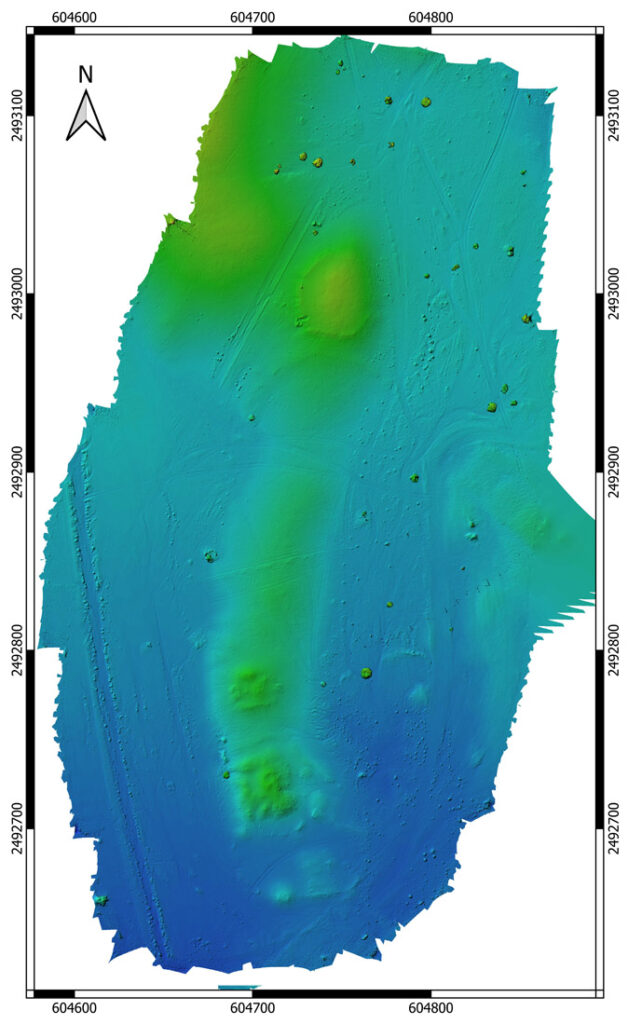
Digital elevation model showing the location of the four large buildings.
The first archaeological excavations in Sinaw took place in 2025. Three squares, each measuring 10 x 10 metres, in Building I in the north of the settlement were excavated. Several fireplaces, a pit filled with ashes, a semicircular stone installation and a large entrance to the hexagonal structure were discovered, as well as Iron Age II pottery and a large number of animal bones. Another test trench was opened to the south of the hillock on which the three large buildings are situated. This revealed a thick layer of ash beneath the current surface, superimposing several stone walls measuring up to 70 centimetres in height. These are referred to as Building IV. The excavations in Building IV also yielded large quantities of charcoal and installations made of organic materials, as well as a significant amount of Iron Age II pottery.
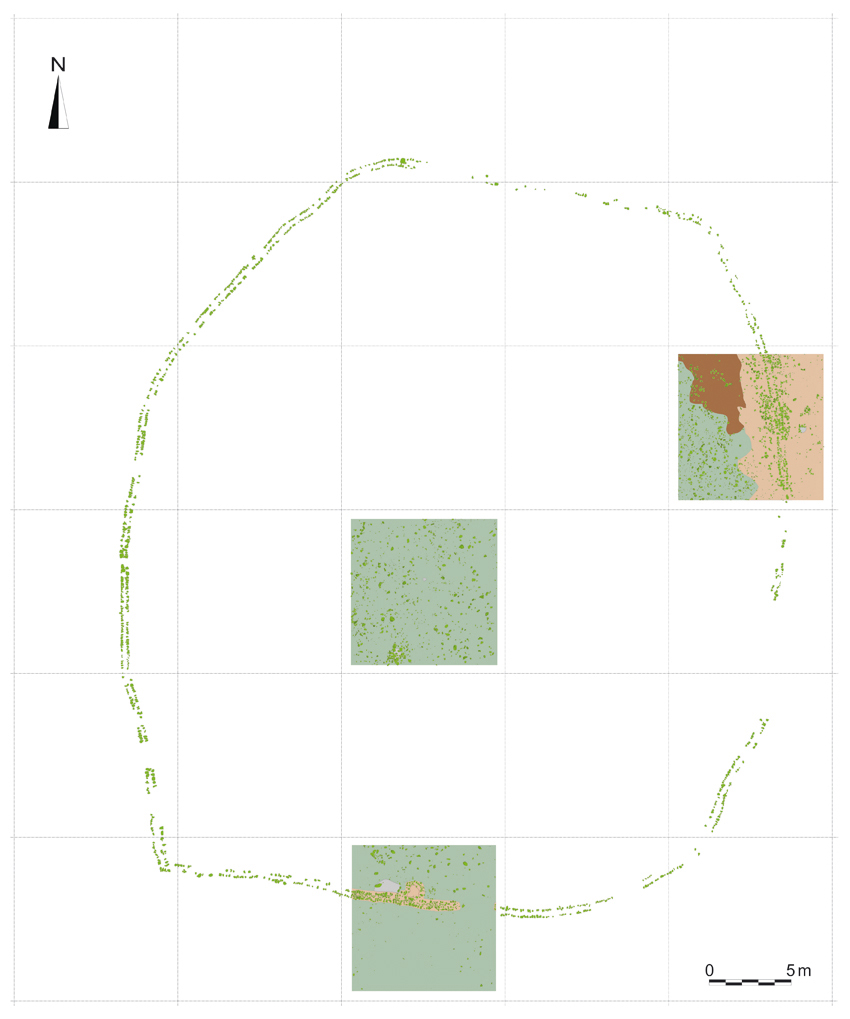
Overall plan of Building I.
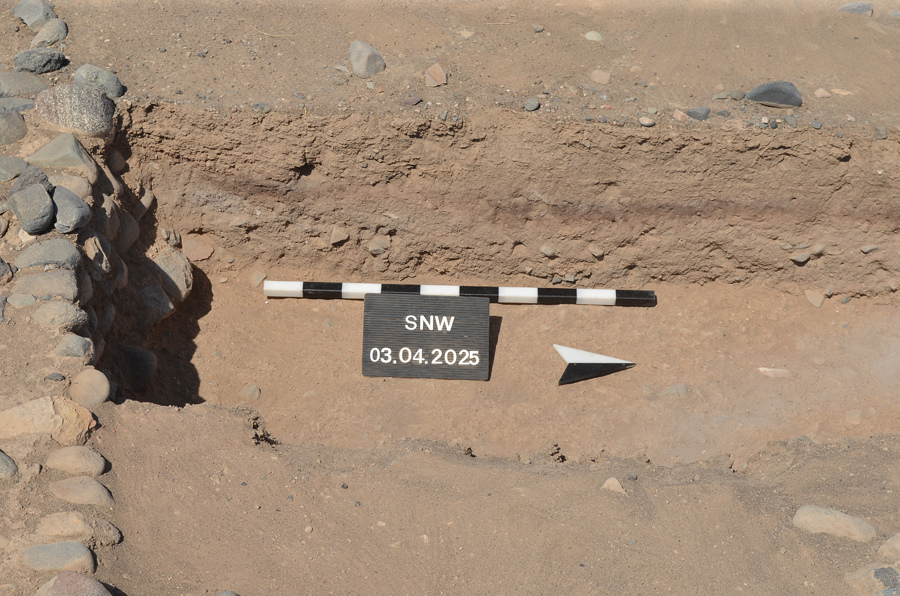
Burned layer in Building IV.
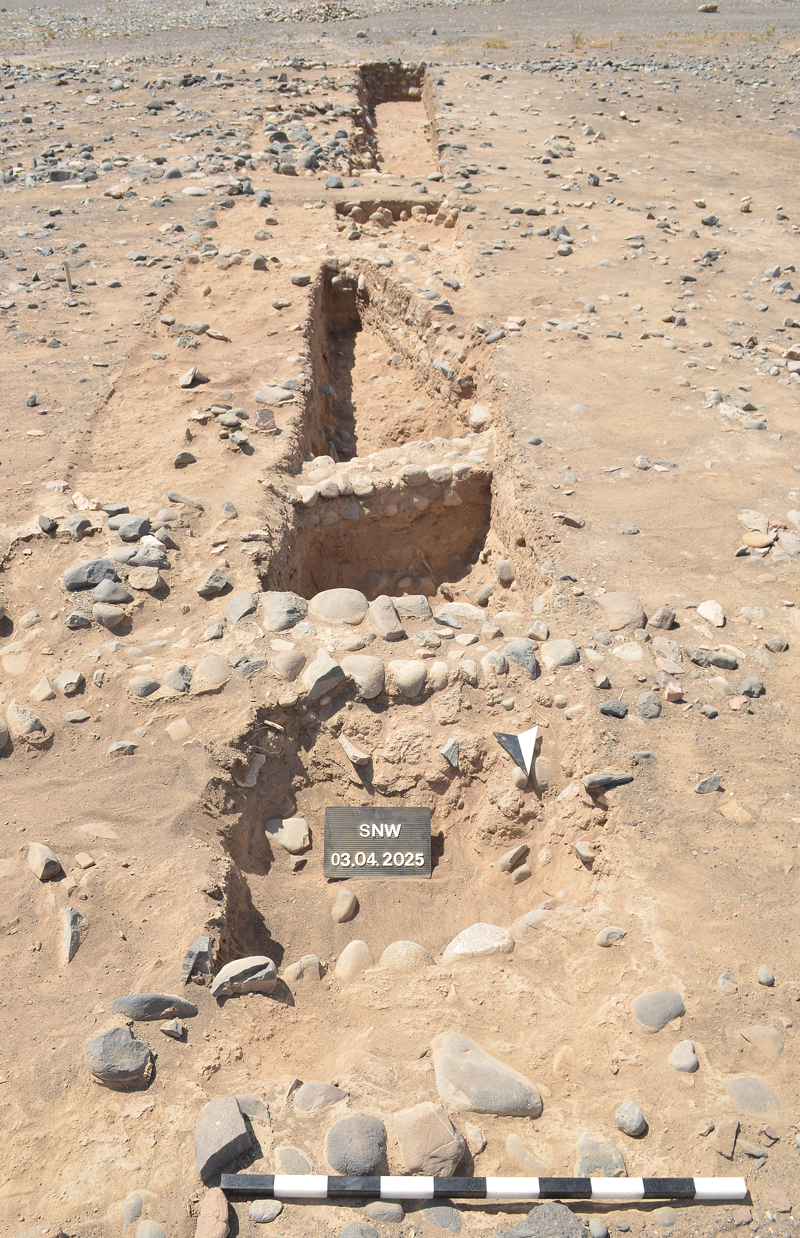
Building IV with numerous stone walls.
Excavations
Since 2026, a team from the University of Tübingen led by Conrad Schmidt is conducting intensive archaeological fieldwork in Sinaw as part of the DFG project „At the fringes of southeastern Arabia’s Iron Age“. This three-year research project will examine the subsistence economy and other features of the Early Iron Age in Central Oman and compare them with those of sites in the north. The project aims to investigate how societies adapted to their environment, sheds light on the availability of natural resources and anthropogenic environmental changes, and seeks to establish a common chronology for southeastern Arabia. Archaeological work is accompanied by archaeobotanical, archaeozoological, and petrographic analyses. Investigations into soil science are also planned for the area around the settlement, where the existence of gardens with irrigation systems is expected.